
Visit Our Patreon or Read Right Below!
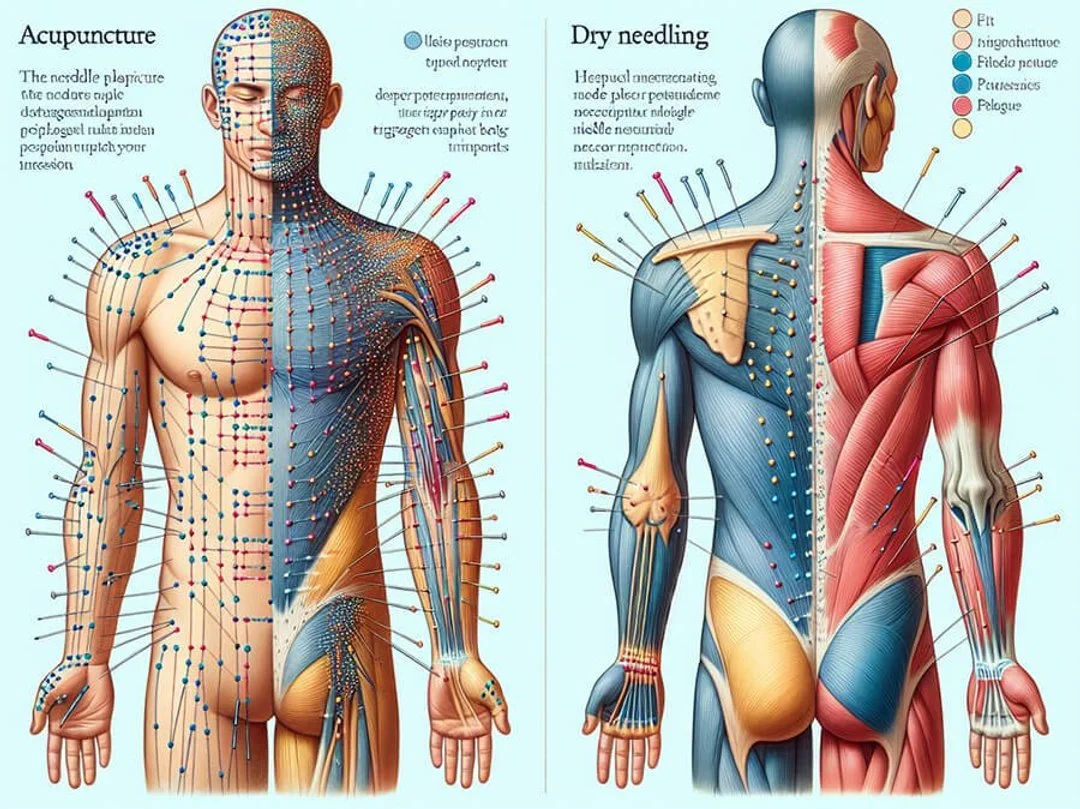
Dry Needling v. Acupuncture
Dry needling and acupuncture may look similar from the outside, but they come from completely different philosophies and clinical approaches. Acupuncture is rooted in a 2,000-year-old system built around Traditional Chinese Medicine and the concept of balancing life energy. Dry needling, on the other hand, developed in the 1980s from neurological and musculoskeletal research, focusing on targeting specific tissues to reduce pain and improve function.
Both use thin, non-injectable needles, but the reasoning behind why and where they’re applied and what the practitioner is trying to influence are fundamentally different. Acupuncture evaluates the mind-body-spirit connection and the flow of energy through meridians. Dry needling evaluates whether a particular muscle or tissue is contributing to pain or dysfunction based on anatomy and physiology.
In practice, either approach can be helpful. The biggest factor in outcomes is often less about the needle and more about the clarity of the evaluation, the intent behind the treatment, and your relationship with the clinician.
The short answer is: both use the same tool, but for different purposes, guided by different reasoning, philosophies, and clinical approaches.
The longer answer:
Let’s start with some brief history. Acupuncture is a school of thought and a therapeutic system within the broader framework of Traditional Chinese Medicine (TCM). It has been practiced for over 2,000 years. Dry needling, as we know it today, originates from the work of Karel Lewit, a Czechoslovakian neurologist, in the 1980s. Lewit originally used subcutaneous injection needles, which are much wider than modern dry needles and have a hollow channel for injecting substances. Think of the needles used for shots or childhood vaccines versus something thinner than a sewing needle.
Lewit’s use of needles focused on producing analgesic effects without pharmaceutical analgesics. Combined with the work of Janet Travell, an American physician who mapped trigger points and muscle referral patterns (where pain is felt in an area different from the source), dry needling emerged as a tool for addressing muscle pain. This differs significantly from acupuncture, whose goal is to balance life energy. A 2,000-year gap and the contrast between East Asian culture and Western medical science naturally create substantial differences.
There are two main similarities:
Both use thin, dry (non-injectable) needles.
Both aim to support a person’s health.
However, even the second point gets complicated, because in TCM, “health” encompasses mind, body, and spirit, whereas in Western medicine it refers to physiological function and tissue homeostasis.
The purpose of the intervention determines everything that comes before it, especially the evaluation and assessment. In TCM, the assessment is holistic and non-physiologic, examining mind, body, and spirit to evaluate the quality and balance of life energy (qi). A clinician who uses dry needling performs a physical exam aimed at determining whether a specific muscle or tissue is appropriate to treat with a needle. Dry needling is applied to anatomically defined structures based on dysfunction, neuroanatomy, and the clinician’s physical assessment.
One nuance: acupuncture can include techniques that influence muscles as well. In that sense, dry needling overlaps with only one aspect of acupuncture. But in TCM, muscle needling is rarely the first-line intervention for muscle pain or tension. TCM has many tools, and practitioners generally ask why the body responded a certain way before simply needling the area.
A brief caveat: Acupuncture also relies on the Meridian system, channels through which qi flows. This is what acupuncture seeks to influence. There is no scientific evidence that Meridians exist as physical structures. Some research notes possible overlap with the nervous or lymphatic systems. While science isn’t the sole measure of truth, it’s fair to say acupuncture principles are not empirically validated in the same way Western anatomy is. Some of these ideas may reflect higher-order concepts we cannot currently measure.
We could go much deeper into the differences between the two. Ultimately, both can produce similar effects. The strongest predictor of your outcome is your relationship with the practitioner, whether they are an acupuncturist, chiropractor, physical therapist, or another clinician. After that, it comes down to your personal preferences and which interventions best support your condition. Some people prefer teas, supplements, exercise, technology-based treatments, short visits, longer relaxation-focused sessions, or other styles of care.
My General Fitness Program
A simple, no-nonsense strength plan that works anywhere.
This program is built for steady muscle and strength gains without needing specialty equipment. You’ll train four days per week, use RIR to guide intensity, and progress with small, consistent load increases. Clear structure, efficient sessions, and movements that build real-world resilience at the rotator cuffs, adductors, core, and deep neck flexors included. If you can move without pain, you’ll make great progress; if you’re dealing with aches, just modify as needed or address recovery first.
You can do this program in almost any gym: commercial, hotel, or private. No special equipment is needed. It’s built for overall muscle growth with steady strength gains. If you’re injury-free and can move without pain, you’ll get excellent results. If you do have pain or injuries let’s get in touch!
How to work the sets:
Set 1: Choose a weight where you finish with about 4–6 reps left in the tank (Reps in Reserve, RIR).
Set 2: Add weight so you’re left with 2–4 RIR.
Set 3: Go heavier, aim to stop just 1 rep shy of failure. This is the money set. The first two sets are your ramp-up; the third is where most of the gains come from.
Adjusting on the fly:
If you finish a set and feel like you could’ve done many more reps, increase the weight.
Example: If Set 1 ends at 12 reps but you feel like you had 8 more in you, go heavier right away.
RIR & RPE quick guide:
RIR (Reps in Reserve): How many good reps you could still do after stopping/finishing the set.
RPE (Rate of Perceived Exertion): Scale of 1–10.
10 = 0 RIR (failure, i.e. you could not complete your last attempt)9 = 1 RIR
8 = 2 RIR
7 = 3-4 RIR
Rest periods:
Take 90–150 seconds (1:30–2:30 minutes) of rest between sets that hit the same muscle. The program is arranged so you can alternate between different muscle groups, this way one group rests while you work another.
4-Day Hypertrophy Plan
Day 1 – Chest + Biceps
Bench Press – 3×10-12, 8-10, 5-8
Barbell/DB Curl – 3×10-12, 8-10, 5-8
Incline DB Press (or Smith)– 3×10-12, 8-10, 5-8
Incline DB Curl – 3×10-12, 8-10, 5-8
Rotator Cuff ER (DBs) – 2×12–15
2nd set have 1-2 RIR
Day 2 – Ant. Legs + Core
Squat – 3×10-12, 8-10, 5-8
Side Bend / Carry – 3×10–12/side
same idea regarding RIR for each set, but the reps won't change so the weight won't change as drastically between sets.Bulgarian Split Squat – 3×6–12
Hanging Leg Raise / Ab Rollout – 3×10–12
Copenhagen Plank – 3×Failure (timed)/side
Day 3 – Lats + Triceps
Row (pref. Machine / alt. Lawn mower) – 3×10-12, 8-10, 5-8
Overhead Triceps Extension/Dips – 3×10-12, 8-10, 5-8
Pull-Ups / Lat Pulldown – 3×10-12, 8-10, 5-8
Rope Pushdown – 3×10-12, 8-10, 5-8
Lateral Raises/ Rear Delt Ext. – 3×10-12, 8-10, 5-8
Deep Neck Flexor Chin Tuck + Lift – 3×Failure (timed)
overtime progress with KB on brow of forehead, performing concentric neck flexion
Day 4 – Post. Legs + Shoulders/Traps
Romanian Deadlift – 3×10-12, 8-10, 5-8
Overhead Press – 3×10-12, 8-10, 5-8
Hip Thrust – 3×10-12, 8-10, 5-8
BB Shrugs / Upright Row / Face Pull – 3×10-12, 8-10, 5-8
Rotator Cuff IR (DBs) – 2×12–15
2nd set have 1-2 RIRsame idea regarding RIR for each set, but the reps won't change so the weight won't change as drastically between sets.
Copenhagen Squeeze – 2×12–15 w/weight (no weights then 2x7-8 RPE)
2nd set have 1-2 RIRsame idea regarding RIR for each set, but the reps won't change so the weight won't change as drastically between sets.
Progression: micro load with 0.25 lb plates.
Efficient: Let’s say 2 mins per set and 2 mins per rest cycle that is 56 mins for a great, steady paced workout. That time is significantly cut if you work differing muscle group during rest periods instead.
Built-in resilience: cuff, adductors, and deep neck flexors trained weekly.